
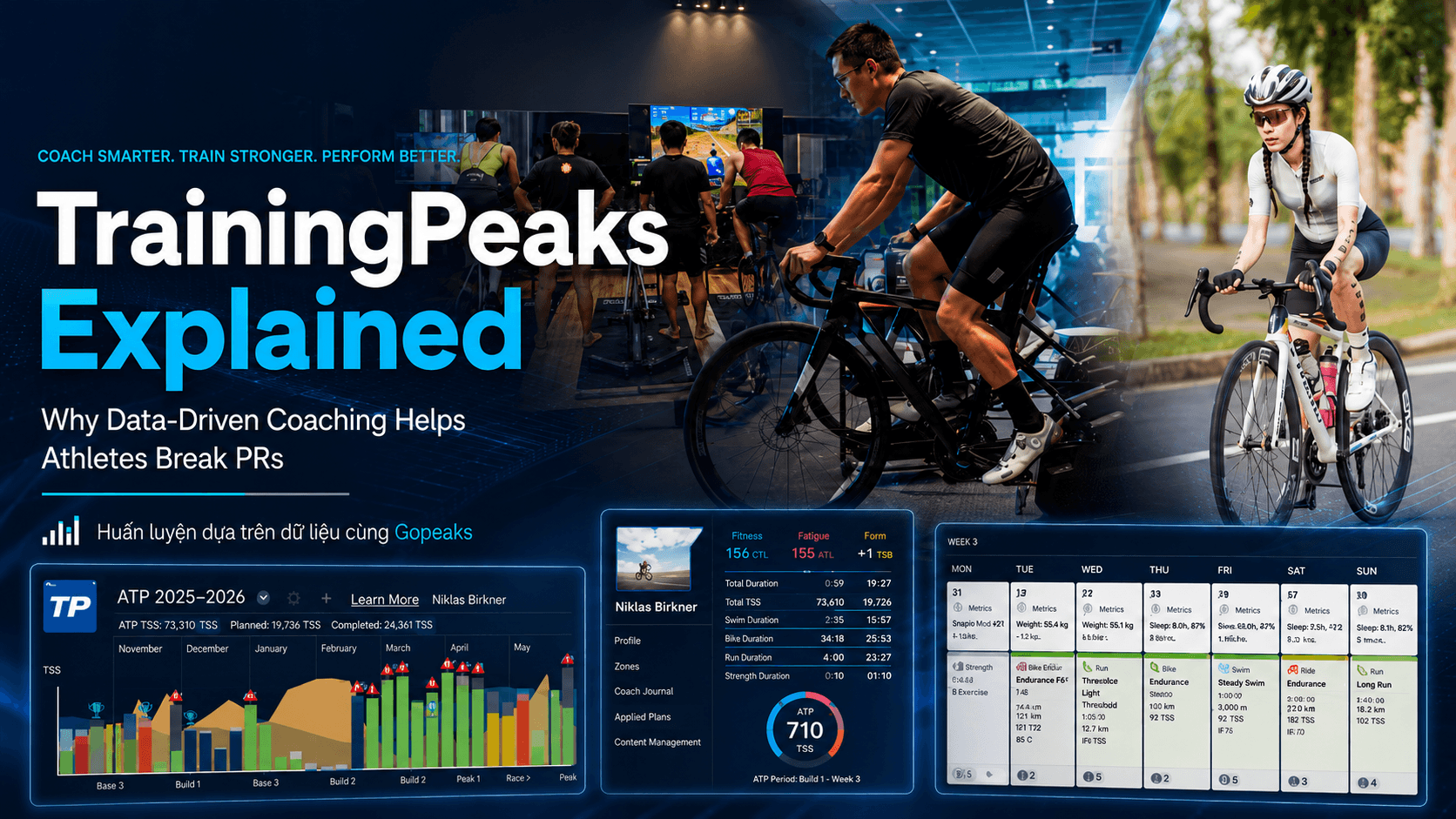
What Is TrainingPeaks and Why Serious Athletes Need to Understand It
Many athletes do not stop improving because they lack effort. They stop improving because they lack the right data, the ability to interpret that data, and a coaching system that can turn numbers into action.
You can run more, ride more, and swim more. But if you do not know how your body is responding, you can easily fall into three common traps: training too easy to create adaptation, training too hard and accumulating fatigue, or training at the wrong time and missing peak performance on race day.
This is why TrainingPeaks has become one of the most important platforms for modern endurance athletes.
TrainingPeaks is not just a workout-tracking app. It is a performance analysis system that helps you understand your training process more deeply: what you did today, how much training load it created, how fatigued your body is, whether your fitness is improving, and when you are ready to race at your best.
At Gopeaks, TrainingPeaks is an essential part of a digital, data-driven coaching ecosystem. Data from GPS watches, smart trainers, power meters, heart rate monitors, and other training devices is not only recorded. It is analyzed by coaches to create a personalized training roadmap for each athlete.
In other words, TrainingPeaks gives athletes the language of data. Gopeaks helps athletes understand and use that language to improve.
How Is TrainingPeaks Different from Garmin, Strava, or Apple Watch?
Garmin, Apple Watch, COROS, Wahoo, and Magene help you record activities. Strava helps you share your journey, connect with the community, and stay motivated. TrainingPeaks plays a different role: it helps you understand the training meaning behind each session.
A GPS device can tell you how many kilometers you ran, your average pace, your average heart rate, your cycling power, and how long the session lasted.
But the more important questions are: Was this workout aligned with the right physiological goal? Was today’s training load appropriate for this week? Are you building fitness or simply accumulating fatigue? Do you need recovery before the next hard session? Are you peaking at the right time?
This is where TrainingPeaks becomes different.
TrainingPeaks does not only record data. It places every workout into the context of a long-term training plan. A tempo run, a sweet spot ride, a technical swim session, or a VO2max interval workout is analyzed in relation to the bigger goal: building fitness, managing fatigue, preparing for competition, and breaking personal records.
What Is Data-Driven Coaching?
Data-driven coaching means coaching based on data. But it does not mean athletes should only look at numbers and ignore how their bodies feel.
True data-driven coaching combines objective data, subjective feedback, coaching experience, and the real-life context of each athlete.
Objective data includes pace, power, heart rate, cadence, TSS, CTL, ATL, and TSB. Subjective data includes RPE, fatigue, sleep quality, stress, and recovery status. Coaching experience helps turn data into the right decisions. Real-life context makes the plan fit around work, family, injury history, training conditions, and race goals.
A good training plan should not only answer the question, “What should I do today?” It should also answer, “Why should I do this workout, at this intensity, at this exact point in the training cycle?”
This is where Gopeaks is different. The Gopeaks coaching system is not based on guesswork or generic plans. Each athlete is monitored through data, progress is analyzed, and training is adjusted based on the athlete’s real response.
The Three Most Important TrainingPeaks Metrics: CTL, ATL, and TSB
One of the most important tools in TrainingPeaks is the Performance Management Chart, often called the PMC.
The PMC helps coaches and athletes understand the relationship between fitness, fatigue, and form. The three core metrics are CTL, ATL, and TSB.
CTL – Chronic Training Load
CTL is commonly understood as “Fitness,” or long-term accumulated training load.
It reflects training load over a longer period. When CTL increases gradually and consistently, it usually means the athlete is building a stronger fitness base.
However, CTL should not increase too quickly. A rapid increase may create short-term improvement, but it can also increase the risk of injury, overload, and burnout.
At Gopeaks, CTL is used to monitor an athlete’s ability to tolerate training load over multiple weeks. A beginner preparing for a 5K, a marathon runner, and a triathlete training for an Ironman will all have very different CTL targets.
ATL – Acute Training Load
ATL is commonly understood as “Fatigue,” or short-term training load.
It reflects recent training stress and responds quickly to heavy training blocks. If you have just completed a demanding build week, ATL will usually rise sharply.
High ATL is not always bad. During a build phase, fatigue is necessary to create adaptation. The key is to manage ATL in relation to CTL.
If ATL rises too high while CTL is not yet developed enough, the body may be carrying more stress than it can adapt to.
TSB – Training Stress Balance
TSB is commonly understood as “Form,” or race readiness.
TSB is calculated from the relationship between CTL and ATL. When ATL is higher than CTL, TSB is usually negative, meaning the body is fatigued. When ATL decreases while CTL remains stable, TSB rises, meaning the body is recovering and becoming more race-ready.
During the taper phase before a race, coaches usually reduce training load so ATL decreases while CTL does not drop too much. The goal is to help the athlete arrive on race day fresh but still fit.
This is why TrainingPeaks is especially important for athletes preparing for marathons, triathlons, Ironman 70.3, or Ironman 140.6. You do not only need to train hard. You need to peak on the right day.
What Is TSS and Why Does It Matter?
TSS stands for Training Stress Score. It is a metric that measures the training load of a workout.
A long session at moderate intensity can create a high TSS. A short but very intense interval session can also create a high TSS. TSS helps coaches compare the load of different workouts and design a more balanced training week.
For triathletes, TSS is especially important because training load comes from three disciplines: swimming, cycling, and running. If you only look at each sport separately, you may think you are still fine. But when the total load from all three sports is combined, your body may already be carrying deep fatigue.
TrainingPeaks brings all training load into one system so coaches can see the full picture.
Why Using TrainingPeaks Alone Is Not Enough
TrainingPeaks is powerful. But because it is powerful, it can also overwhelm athletes with too much information.
New users often face three problems.
First, there are too many metrics. TrainingPeaks includes data such as TSS, IF, CTL, ATL, TSB, pace, heart rate, power, cadence, elevation, compliance, and many others. Not every metric matters equally. The key is not to look at everything, but to know which metrics matter at each stage of training.
Second, athletes can become obsessed with workout colors. TrainingPeaks uses colors to show workout completion. This is useful, but it can also create pressure. A workout that is not completed as planned may be a sign that the body needs recovery, or that the plan needs adjustment.
Third, data without context can lead to poor decisions. A negative TSB can be normal during a build phase. A high CTL can be positive if the athlete is adapting well, but it can also be risky if it comes with poor sleep, persistent soreness, or excessive fatigue.
This is why Gopeaks does not simply deliver workouts through TrainingPeaks. Gopeaks acts as the analysis and interpretation layer, helping athletes understand what is happening and what should be adjusted.
How Gopeaks Uses TrainingPeaks
Gopeaks builds its coaching system on four main layers: data collection, data analysis, personalized planning, and continuous adjustment.
The first layer is data collection. Data is synced from GPS watches, smart trainers, power meters, heart rate monitors, and training platforms. The goal is to reduce manual input and make sure the data reflects real training as accurately as possible.
The second layer is data analysis. Coaches review metrics such as TSS, CTL, ATL, TSB, pace, power, heart rate, cadence, fatigue trends, and workout compliance. Data is not viewed in isolation. It is interpreted within the context of race goals, training phase, lifestyle, and subjective athlete feedback.
The third layer is personalized planning. There is no single plan that works for everyone. An athlete preparing for Ironman needs to distribute load across swimming, cycling, and running. A runner trying to break a 5K PR needs speed, lactate threshold development, running economy, and neuromuscular recovery. A cyclist trying to improve FTP needs a structured power-based progression.
The fourth layer is continuous monitoring and adjustment. Once the athlete completes a workout, the data is synced. Coaches can review the real response and adjust upcoming workouts when needed.
This is the difference between a fixed training plan and a true coaching system.
TrainingPeaks for Triathlon: Balancing Swim, Bike, and Run
Triathlon is not simply training three separate sports. The biggest challenge is managing total load across all three disciplines.
An athlete may feel that each session is not too hard. But when the weekly load is combined, the total stress can exceed the body’s ability to recover.
TrainingPeaks helps Gopeaks coaches answer key questions. Is the run load too high compared to the athlete’s current base? Will today’s cycling intervals affect tomorrow’s long run? Is the recovery swim truly helping, or is it adding more stress? When should volume increase? When should training load be reduced? How should race week taper be structured?
For distances such as Ironman 70.3 or Ironman 140.6, managing training load is not optional. It is essential for improving performance while reducing injury risk.
TrainingPeaks for Cycling: When Watts Become the Language of Coaching
In cycling, power is one of the most objective training metrics. Heart rate can be affected by heat, caffeine, sleep, and stress. But watts show exactly how much power you are producing.
TrainingPeaks helps cyclists track FTP, power zones, TSS, Intensity Factor, time in zone, peak power, fatigue resistance, and progress trends across training cycles.
With Gopeaks’ virtual cycling rooms and smart trainer system, power data becomes even more accurate and useful. Athletes no longer ride only by feel. They can train in the right power zone, for the right physiological goal, at the right stage of development.
TrainingPeaks for Running: More Than Just Pace
In running, many athletes focus only on pace. But pace does not always reflect true effort.
Running at 5:30/km on flat ground is very different from running 5:30/km uphill, in hot weather, or after a heavy training week. TrainingPeaks helps combine pace with heart rate, elevation, perceived effort, and total training load to evaluate running sessions more accurately.
For runners who want to break a PR, the goal is not simply to run faster all the time. The key is knowing when to run easy, when to run tempo, when to run intervals, when to run long, and when to recover.
The Formula for Breaking PRs: Right Data, Right Coaching, Right Recovery
A personal record does not come from one single workout. It comes from consistent and well-managed adaptation.
To break a PR, athletes need to build a strong fitness base, increase training load gradually, train in the right intensity zones, recover at the right time, avoid injury, taper properly before race day, and execute the right race strategy.
TrainingPeaks helps measure this process. Gopeaks helps turn the data into specific coaching decisions.
This is the secret of modern endurance coaching: no guessing, no random training, and no copying someone else’s plan. Each athlete needs a personal roadmap built from their own data.
Conclusion: TrainingPeaks Works Best When a Coach Knows How to Read the Data
TrainingPeaks is a powerful performance analysis platform for endurance athletes. It helps you understand training load, fitness, fatigue, form, and race preparation.
But data only becomes valuable when it is interpreted correctly.
A number can tell you what is happening. A good coach helps you understand why it is happening, whether it matters, and what you should do next.
That is the role of Gopeaks in the digital coaching ecosystem: connecting technology, data, coaching expertise, and a deep understanding of each athlete.
Whether you are preparing for your first 5K, your first marathon, an Ironman 70.3, or your next personal record, TrainingPeaks can help you see the journey clearly. Gopeaks helps you follow the right path.
It is time to stop training by guesswork. Start training with data, through a personalized coaching roadmap from Gopeaks.
FAQ
What is TrainingPeaks?
TrainingPeaks is a training management and performance analysis platform for endurance athletes. It helps athletes and coaches track workouts, training load, fitness, fatigue, and race readiness.
Is TrainingPeaks suitable for beginners?
Yes. Beginners can use TrainingPeaks to receive structured workouts, track progress, and build consistent training habits. However, beginners benefit greatly from having a coach explain the data.
What are CTL, ATL, and TSB in TrainingPeaks?
CTL reflects long-term fitness, ATL reflects short-term fatigue, and TSB reflects form or race readiness. These metrics are commonly used to manage training load and taper before races.
What is TSS?
TSS stands for Training Stress Score. It measures the training load of a workout and helps coaches plan weekly training more effectively.
How is TrainingPeaks different from Strava?
Strava focuses on social sharing, community, and motivation. TrainingPeaks focuses on performance analysis, training load management, and long-term coaching structure.
How does Gopeaks use TrainingPeaks?
Gopeaks uses TrainingPeaks to deliver workouts, monitor data, analyze training load, and personalize training plans for each athlete based on their goal, fitness level, and real training response.