
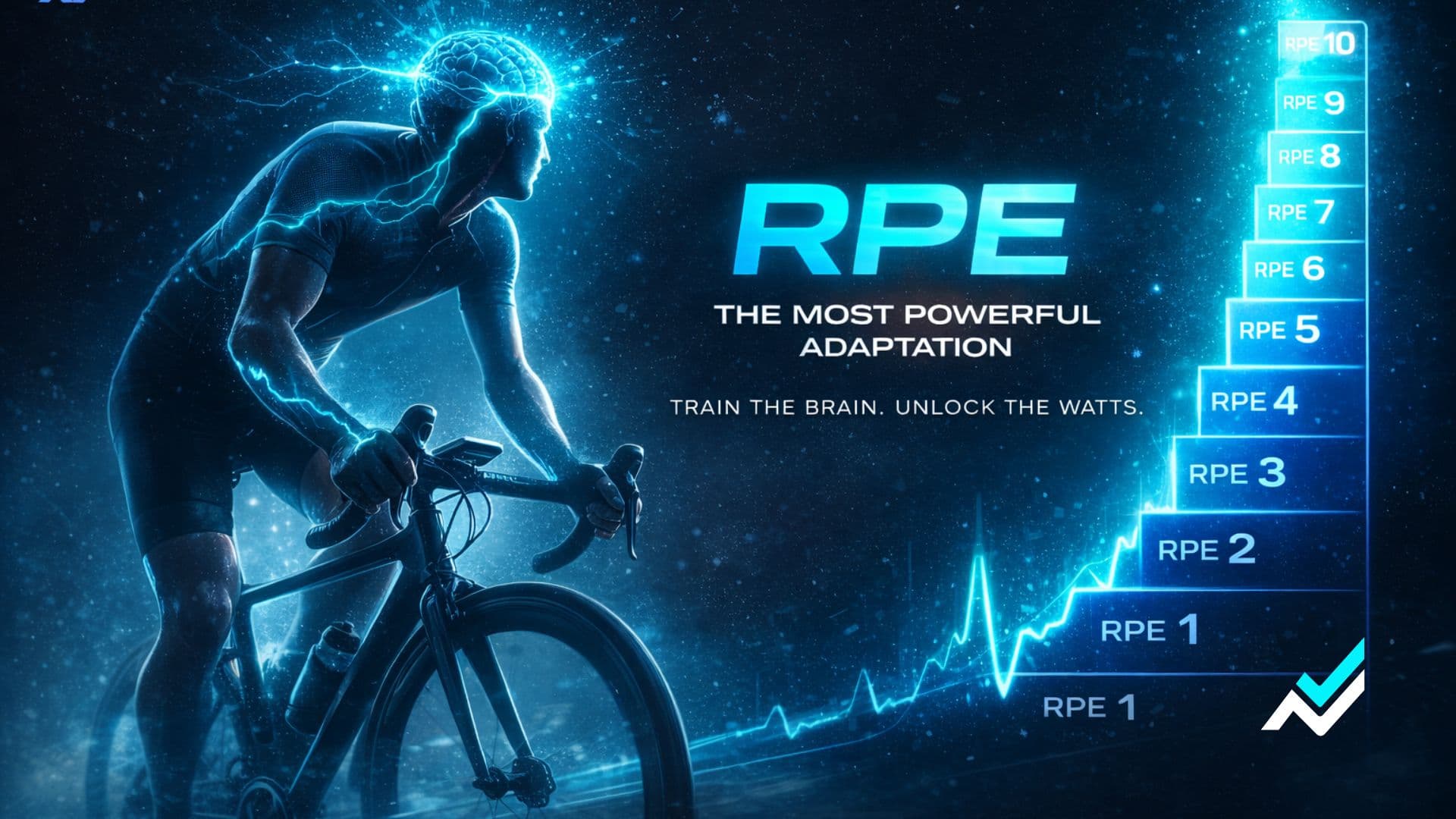
Training RPE: Why Perceived Exertion Might Be Your Most Powerful Adaptation
In endurance sports, we love numbers.
VO₂max.
FTP.
Lactate threshold.
CTL.
Power curves.
We measure everything that can be measured. We analyze every watt, every heartbeat, every millimole of lactate. But there is a question we rarely ask seriously:
What truly makes you slow down?
Is it because your body has run out of capacity?
Or because your brain has decided you’ve reached the limit?
If you’ve ever had a day when the data said you were “fine” but you couldn’t push 10 more watts, you’ve touched this issue. And if you’ve ever had the opposite—a day when your numbers weren’t exceptional but you still set a personal best—you’ve experienced it too.
Between physiology and real-world performance, there is an interface. Its name is RPE — Rate of Perceived Exertion.
What Is RPE — In Simple Terms?
RPE is how hard the effort feels to you.
Not what your watch says.
Not what your power meter says.
Not what your lactate value says.
It is your internal experience of intensity.
Most commonly, RPE is measured on a 1–10 scale:
1 – Extremely easy
3 – Comfortable conversation pace
5 – Breathing deeper, but controlled
7 – Difficult, conversation limited
8 – Near threshold, high focus required
9 – Very hard, close to your limit
10 – Maximal effort, unsustainable
RPE does not measure muscle output directly.
It does not measure oxygen consumption.
It does not measure power.
It measures how your brain interprets the total stress in that moment.
And that is precisely why it matters.
RPE Is Not Just a Subjective Afterthought
Many athletes treat RPE as something to fill in at the end of a workout. But from a neuroscience perspective, perceived exertion is not vague at all. It is the integrated output of multiple systems processed by the brain in real time.
Muscle tension.
Breathing rate.
Cardiovascular strain.
Metabolic byproducts.
Cognitive load.
Emotional state.
Background stress.
Your brain does not read FTP percentages. It does not calculate 97% versus 102% of threshold. It evaluates risk.
It asks one fundamental question:
“Is this safe? Is this sustainable?”
If the answer is uncertain, it reduces output.
That means you can stop not because you have truly reached your physiological ceiling, but because your central control system has made a protective decision.
Performance Is Not Just Physiology — It Is Perceived Physiology
For years, we believed performance was dictated almost entirely by muscles and cardiovascular capacity. Increasingly, evidence suggests that what determines whether you can fully express that physiology is perception.
Two athletes with a 300W FTP.
One holds 280W for 45 minutes.
The other holds it for 32 minutes.
Same physiology. Same numbers.
The difference lies in tolerance of discomfort and trust in one’s limits.
There are days when you know you are fit. The data confirms it. But when the attack happens, something inside says “no.” You cannot access that performance.
Other days, your fitness metrics are average—but you override the signal and push beyond expectations.
That is RPE shaping performance.
The Gap Between True Limits and Perceived Limits
An important distinction:
Physiological limits and perceived limits are not always identical.
Your body may still have 5% left.
But if your brain interprets the situation as risky, it will reduce output before you actually reach that ceiling.
Training RPE is about narrowing that gap.
Not recklessly ignoring warning signs.
But learning to distinguish between:
Dangerous fatigue
And discomfort that is simply part of high performance
RPE Can Be Trained
The critical insight is not that RPE influences performance. It’s that it can be improved.
When athletes systematically train their ability to recognize and tolerate exertion over 4–6 weeks, we often see sustained power increases of 10–30 watts without increasing training load.
No extra volume.
No additional intervals.
No added TSS.
Just improved interpretation of effort.
This is not about becoming “tougher.” It is about refining a neural skill.
Athletes learn to differentiate true physiological collapse from exaggerated perception. They pace more accurately. They panic less when lactate rises. They understand where their redline actually is—and trust it.
Cognitive Load: The Silent Performance Killer
One of the most overlooked influences on RPE is mental fatigue.
A stressful workday.
Long meetings.
Travel.
Mild sleep deprivation.
Constant digital stimulation.
All of these raise baseline perceived exertion before training even begins.
You start an interval session already mentally taxed. Everything feels 1–2 points harder on the RPE scale.
You did not suddenly lose fitness.
You are overloaded.
At the professional level, managing cognitive load is as important as tapering physical load. Reducing mentally draining commitments. Preparing logistics early. Simplifying the environment before race day.
If the brain is fatigued, strong legs cannot express themselves.
How to Train RPE Systematically
Training RPE does not mean abandoning data. It means knowing when to disconnect from it.
The first step is “unplugged” sessions.
Threshold intervals without watching power. Tempo rides without heart rate. Athletes focus on breathing, muscular tension, mental strain.
Once internal calibration develops, data returns. Compare perception with output. Was that 8/10 truly sweet spot—or were you already at threshold?
Alignment between internal and external metrics begins to form.
Next comes stress layering.
Group rides. Heat exposure. Tactical uncertainty. The brain learns to maintain accuracy under pressure.
Finally, race simulation.
Not just to test fitness—but to test perception control when heart rate spikes, competitors surge, and discomfort rises.
At this point, RPE becomes a tactical tool.
RPE Does Not Replace Physiology — It Expresses It
Perceived exertion does not dismiss VO₂max or FTP. It is how those capacities show up in real competition.
You may have a 350W FTP.
But if your brain limits you to 330W in a decisive moment, 350W remains unused potential.
By training RPE, athletes can:
Pace long efforts more effectively
Tolerate higher workloads without increasing volume
Maintain performance under pressure
Extract more from existing physiology
In endurance sports, where margins of victory are sometimes only a few watts, expanding perceived limits may be the most powerful adaptation available.
The Final Question
When you stop on that climb, what truly made you stop?
Were your muscles out of fuel?
Or did your brain make the decision first?
If it is the latter, you do not necessarily need more intervals. You need to train perception.
RPE is not a minor line in your training log.
It is a window into how you experience effort.
And when you learn to adjust that window, you can expand performance without changing physiology.
In endurance sports, victory does not belong only to the strongest athlete.
It belongs to the athlete who can fully access the strength they already possess.
And sometimes, that begins with understanding how hard something truly feels.