
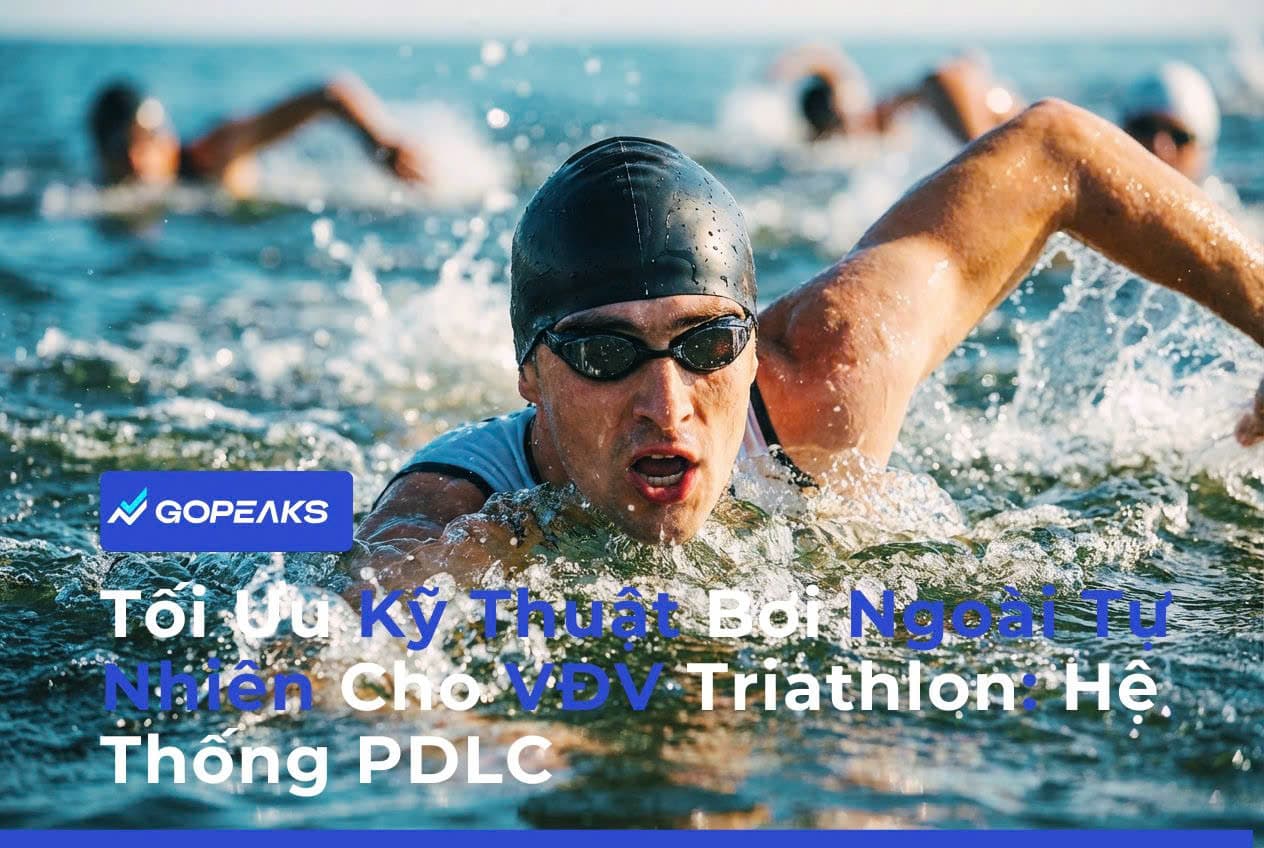
Optimizing Open Water Swimming for Triathletes: The PDLC Framework
Optimizing Open Water Swimming For Triathletes: From Mindset To Real-World Performance
Introduction: The Swim Split—A Triathlete’s Bottleneck
In the triathlon community, the swim leg is often regarded as the most technical challenge and a significant psychological barrier for many athletes. Experience shows that simply transplanting pool swimming techniques into open water environments rarely yields optimal results. To swim faster and, more importantly, to conserve energy for the 40km bike and 10km run segments, athletes need a different approach: focusing on movement efficiency rather than purely building aerobic fitness.
1. The Paradox Between Pool and Open Water Swimming
The difference between these two environments lies in external variables that, without proper training, can quickly lead an athlete to panic or exhaustion.
Pool Environment: An Illusion of Stability
Pools provide an ideal setting: flat water calmed by lane lines that suppress waves, clear floor markings for navigation, and zero physical contact. While great for fine-tuning micro-movements, it can foster "lazy" habits regarding sighting and balance.
Open Water: A Battle Against Chaos
When stepping into natural waters, athletes must confront:
Waves and Currents: Requiring a more flexible swimming rhythm to avoid being swept off course.
Physical Contact: Swimming simultaneously with hundreds of people creates psychological pressure and water turbulence.
Sighting (Navigation): Without floor markings, athletes must lift their heads to find buoys to maintain a straight path.
Common Mistake: Many triathletes attempt to compensate for a lack of speed by increasing the volume of high-intensity intervals in the pool. However, if technical limiters—such as sinking hips or crossovers—are not addressed, this effort only leads to accumulated fatigue without improving actual race-day speed.
2. The PDLC Framework: Four Pillars of Endurance Swimming
Rather than obsessing over minor details like finger spacing, the PDLC method focuses on four core skills that fundamentally transform a triathlete's stroke.
P - Posture: Hydrodynamics and Streamlining
Posture is the foundation of all underwater movement. The ultimate goal is to swim "on top" of the water rather than "through" it.
The Issue (The Sinking Hip): When athletes lift their heads too high to sight, biomechanics dictate that the hips and legs will sink deeper into the water. This creates massive drag, much like swimming with an emergency brake engaged.
Vishark’s Solution: Always point your nose directly at the bottom of the pool or seabed. To navigate effectively without losing form, learn the "roll eyes" technique—looking up through the top of your goggles—or perform a lightning-fast "sighting" head lift immediately after the catch phase, then instantly return your head to a neutral position. Proper posture keeps the hips and heels at the surface, allowing the body to glide with minimal resistance.
D - Direction: Tracking and Axial Stability
Directional stability determines the actual distance you swim. In open water, a deviation of just 1-2 degrees can result in hundreds of meters of wasted effort.
The Issue (The Crossover): A "crossover" occurs when the hand enters the water across the body’s centerline. This causes the torso to fishtail like a pendulum, destroying axial stability and wasting significant energy.
Supplemental Drill (Penguin Swimming): Practice entering the water slightly wider than shoulder-width (like a penguin). For those prone to crossing over, this "wide" sensation actually brings the hands into perfect alignment with the shoulders, ensuring propulsion is driven straight backward rather than dissipated sideways.
L - Length: Stroke Extension and Lat Power (Rotation)
This is the most significant departure from pool swimming. The ability to utilize body roll is the key to lengthening the stroke without overstressing the shoulders.
The Issue (The Tugboat Stroke): Swimming "flat" without rotation shortens the stroke and places the entire load on the small muscles of the shoulder (rotator cuff). This is a leading cause of "swimmer’s shoulder" injuries among triathletes.
The Solution: By slightly rotating the torso with every reach, athletes can engage the latissimus dorsi—the most powerful muscles in the upper body—to generate force. This movement not only increases stroke length and speed but also protects the shoulder joints over long distances.
Supplemental Drill (Belly to the Wall): Practice rotating your torso so your belly faces the side walls with each stroke to help the brain internalize the sensation of axial rotation.
C - Catch: Propulsion and Efficiency
A precise catch is the final step in converting technique into actual velocity.
The Issue (The Death Move): A "dropped elbow" during full extension prevents the athlete from "grabbing" the water. Consequently, the hand slips through the water without creating effective propulsion.
The Solution (Early Vertical Forearm): As the hand enters at full extension, actively point the fingers down toward the bottom and maintain a high elbow to create a solid "paddle" from the hand to the elbow.
Supplemental Drill (Windmill): Keeping the arms straight during the recovery phase helps athletes feel the rhythm and establish a more decisive entry point.
3. Training Roadmap: Quality Over Quantity
To master PDLC, the training process must be broken down and executed with patience.
Single Focus: Do not try to fix every error in one session. Dedicate each workout to feeling a single skill (e.g., focusing only on high hips today) to allow the nervous system and muscles to adapt.
Exaggerated Drills: Drills are designed to "exaggerate" the correct sensation, helping the brain memorize new movement patterns faster.
Technique Before Fitness: This is the core philosophy of Vishark. Experience at professional training camps has proven that even when fatigued at the end of a week, an athlete with superior technique can swim faster than a fit athlete with poor form. Slow down to swim correctly, and you will eventually find yourself swimming faster than ever.
Conclusion: Strategic Mastery Through Every Stroke
In a triathlon, the swim leg isn't necessarily where you win the race, but it is certainly where you can lose it. Mastering the four PDLC skills not only makes you faster but, more importantly, allows you to exit the water with a stable heart rate and fresh legs, ready to conquer the bike and run. Turning a weakness into a strategic advantage is what separates a finisher from a winner.