
Designing Your Peak Performance Roadmap: The Art and Science of YTP
In the world of endurance sports, we often hear the saying: "Fail to plan is planning to fail."
At Gopeaks, we don't just hand you isolated workouts; we work with you to build a long-term roadmap to the summit. Designing a Yearly Training Plan (YTP) is how we draw the "treasure map" so that every athlete can reach the finish line with the brightest smile. Let’s join Gopeaks Coaches in exploring the art and science behind building a YTP – the master key to breaking your personal limits.
1. WHAT IS YTP? WHY IS IT THE "BACKBONE" OF SUCCESS?
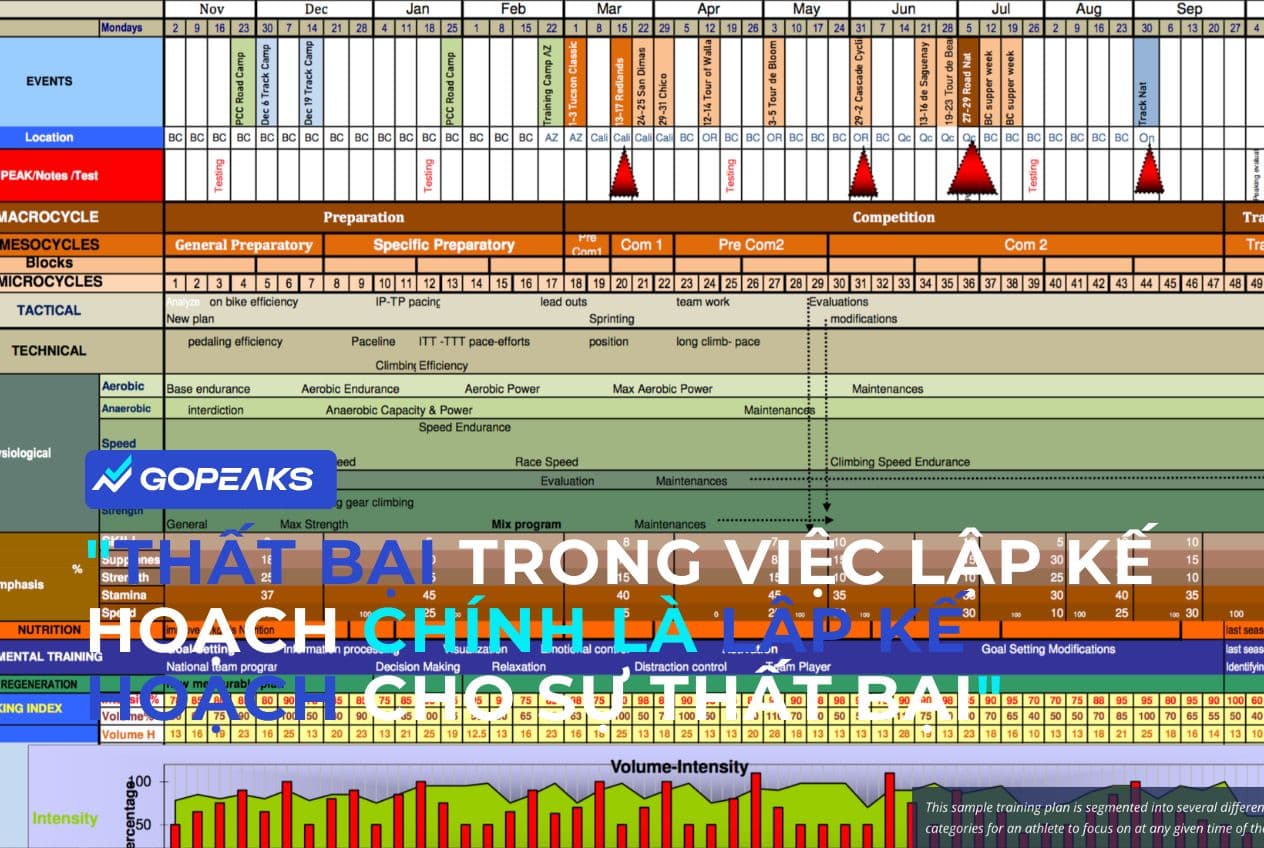
Conceptually, the Yearly Training Plan (YTP) has existed in elite sports for decades. With a YTP, you can visualize your entire season: from accumulation phases and key milestones to target events.
Why do you need a systematic approach? The main reason for building a YTP is to create a structured allocation of three core elements: Training – Competition – Recovery.
Consistency: YTP prevents training based on random inspiration or copying inappropriate plans.
Measurability: It helps you and your Coach record, manage, and measure every aspect of the training process.
Predictability: A comprehensive plan allows us to prepare better for the future instead of just reacting to the present.
Designing a YTP is a high-level form of coaching art. It’s not just about numbers; it’s distilled from the Coach’s experience, your training history, and the latest scientific research.
2. PERIODIZATION: HOW WE "NAME" YOUR PERFORMANCE
The essence of a smart YTP lies in Periodization. Instead of training at a single intensity, we divide the season into cycles with precisely calculated "peaks."
Macrocycles (The Big Picture): Typically spans a full year (about 52 weeks). For athletes aiming for long-term development or professional transition, a Macrocycle can be designed to last 3 to 5 years.
Mesocycles (Intermediate Phases): Usually lasting 4 to 6 weeks, focusing on a specific quality: General Prep, Specific Prep, Pre-Competition, and Transition.
Microcycles (Weekly Implementation): The 7-day weekly unit, personalized for neural adaptation (technique) and metabolic adaptation (energy systems).
3. DESIGNING YTP BASED ON THE INDIVIDUAL
Before building a YTP, Gopeaks Coaches need to understand you deeply through three key metrics: Chronological Age, Biological Age (lifestyle/nutrition), and Training Age (years of experience).
4. LTAD MODEL: A LIFELONG VISION FOR SPORTS
We apply the Long-Term Athlete Development (LTAD) model to help you stay committed to your passion for life. Determining your current stage—whether "Learning to Train" or "Training to Win"—is vital for directing the YTP's focus.
5. BACKWARD PLANNING: REVERSE ENGINEERING FOR PRECISION
At Gopeaks, we often start from your most important race and build the plan backward. This ensures you hit peak form exactly on Race Day and helps determine the optimal total volume to avoid injury.
6. YTP AS A "LIVING DOCUMENT"
A YTP is not a rigid plan. It requires constant monitoring and adjustment based on your feedback. Your Coach will work with you to decide on reporting methods and data types to optimize the roadmap around your race schedule and personal life.
CONCLUSION Building a YTP is an art that takes years to master. A solid yearly plan will take you much further than any isolated high-intensity workout. Let a Gopeaks Coach help you personalize your own map.