
Mastering Indoor Cycling: Building a Global Performance Foundation with TrainingPeaks Virtual
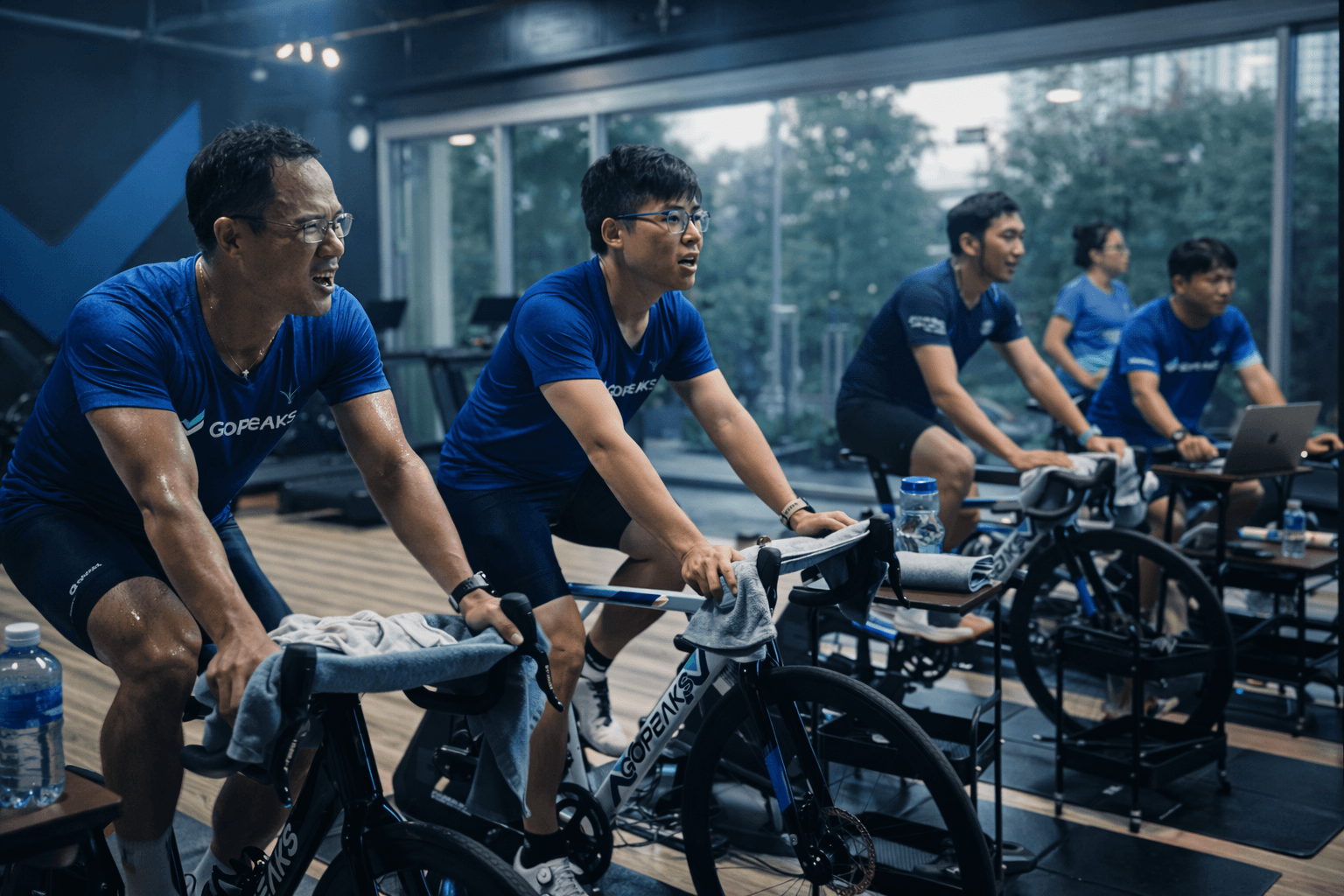
When I decided to open the GoPeaks Indoor Cycling rooms, it was never just about equipment or square meters.
It was about connection.
I didn’t want to create a space where people show up, ride, and leave. I wanted a place where members meet offline, see each other suffer through the same intervals, finish the same hard session, and then sit down afterward to talk about the next goal.
Community is not built in a group chat.
Community is built in shared effort.
Our indoor cycling rooms were designed as physical connection points — where athletes who share long-term ambitions train together in the real world, not just through screens. From that foundation, a larger objective naturally followed: building a system strong enough to compete on the global stage.
From Backup Option to Strategic Environment
Not long ago, indoor cycling was a compromise.
Bad weather.
Limited daylight.
A busy schedule.
Today, it is something entirely different.
Indoor cycling has evolved into a controlled performance environment — one where adaptation can be engineered, measured, and repeated with precision.
At GoPeaks, we use TrainingPeaks Virtual as the platform for structured execution. This allows us to:
Deliver fully structured workouts
Control intensity precisely
Sync data in real time
Track long-term performance trends
Technology is not the differentiator.
The differentiator is how technology is used within a long-term system.
Why Indoor Cycling Supports a Global Vision
High-level performance is not built on motivation. It is built on:
Repeatability
Stability
Measurable progression
Outdoor riding introduces too many variables — traffic, terrain changes, interruptions, environmental stress.
Indoor training removes noise. It allows us to:
Hit exact power targets
Maximize time efficiency
Manage training load precisely
Reduce unnecessary risk
For an organization aiming to develop athletes capable of competing internationally, indoor cycling is not secondary. It is foundational.
Overload with Structure
A well-designed overload week illustrates this clearly.
Many athletes assume improvement requires simply riding longer. In reality, performance gains come from:
Increasing load at the right time
Respecting recovery capacity
Planning deload periods strategically
Indoor cycling allows us to increase training load by 50–100% in a controlled manner — without guessing.
But overload without structure becomes fatigue without adaptation.
Training is not about suffering more. It is about distributing stress intelligently across:
Aerobic base work
Threshold development
VO2max stimulus
Recovery
That principle remains unchanged — regardless of environment.
ERG Mode, RPE, and Control
One of the advantages of TrainingPeaks Virtual is structured execution through ERG control.
Intervals are delivered precisely.
Power targets are maintained.
There is no “coasting” through key segments.
However, power output is only an external metric.
Perceived effort (RPE) remains critical.
If athletes rely solely on numbers, they lose the ability to self-regulate in real-world racing conditions. On race day, there is no ERG mode.
Therefore, indoor cycling at GoPeaks is used to build:
Discipline
Intensity control
Internal awareness
Technology supports the process. It does not replace athlete intelligence.
Racing Indoors: Psychological Demands
Indoor competition creates a specific type of athlete:
Fast response to intensity changes
Sustained high power output
Minimal passive recovery
High psychological pressure
Unlike outdoor racing, there is often no drafting lull, no environmental distraction — just continuous effort.
This develops resilience.
But for athletes aiming at international racing, indoor performance must be paired with outdoor tactical development. Pack dynamics, positioning, and terrain management cannot be fully simulated indoors.
Indoor builds the engine.
Outdoor refines the weapon.
The Indoor Room as a Performance Center
The GoPeaks indoor system was built around three objectives:
1. Data Standardization
Stable power measurement
Heart rate synchronization
Longitudinal tracking
Power-to-HR relationship analysis
2. Structured Periodization
Base
Build
Peak
Race
Indoor protects the structure from disruption.
3. Culture of Discipline
On-time execution
Structured completion
Long-term focus over short-term emotion
International performance is built through repetition with intent.
Coaches Before Equipment
Equipment can be purchased.
Systems must be developed.
To support long-term international ambitions, GoPeaks invests heavily in coach education aligned with the competency standards of USA Triathlon and USA Cycling.
This includes:
Exercise physiology understanding
Structured season planning
Load and recovery management
Data analysis proficiency
Communication and long-term athlete development
The goal is not impressive workouts.
The goal is sustained progression across seasons.
From Indoor to International Competition
The pathway is deliberate:
Build aerobic and metabolic foundation indoors
Standardize intensity and load management
Develop a core athlete group
Add tactical outdoor sessions
Target strategic race calendars
Peak with intention
Indoor cycling is the starting point — not the finish line.
Conclusion
Indoor cycling has evolved.
It is no longer a weather solution.
It is a performance platform.
When we opened the GoPeaks indoor cycling rooms, it was not simply about creating another training space. It was about building:
A connected community
A structured performance system
A foundation capable of supporting global ambition
The world does not care where you train.
It cares how strong you are when you line up.
And that journey can begin inside a room — where athletes ride together, improve together, and aim far beyond the walls around them.