
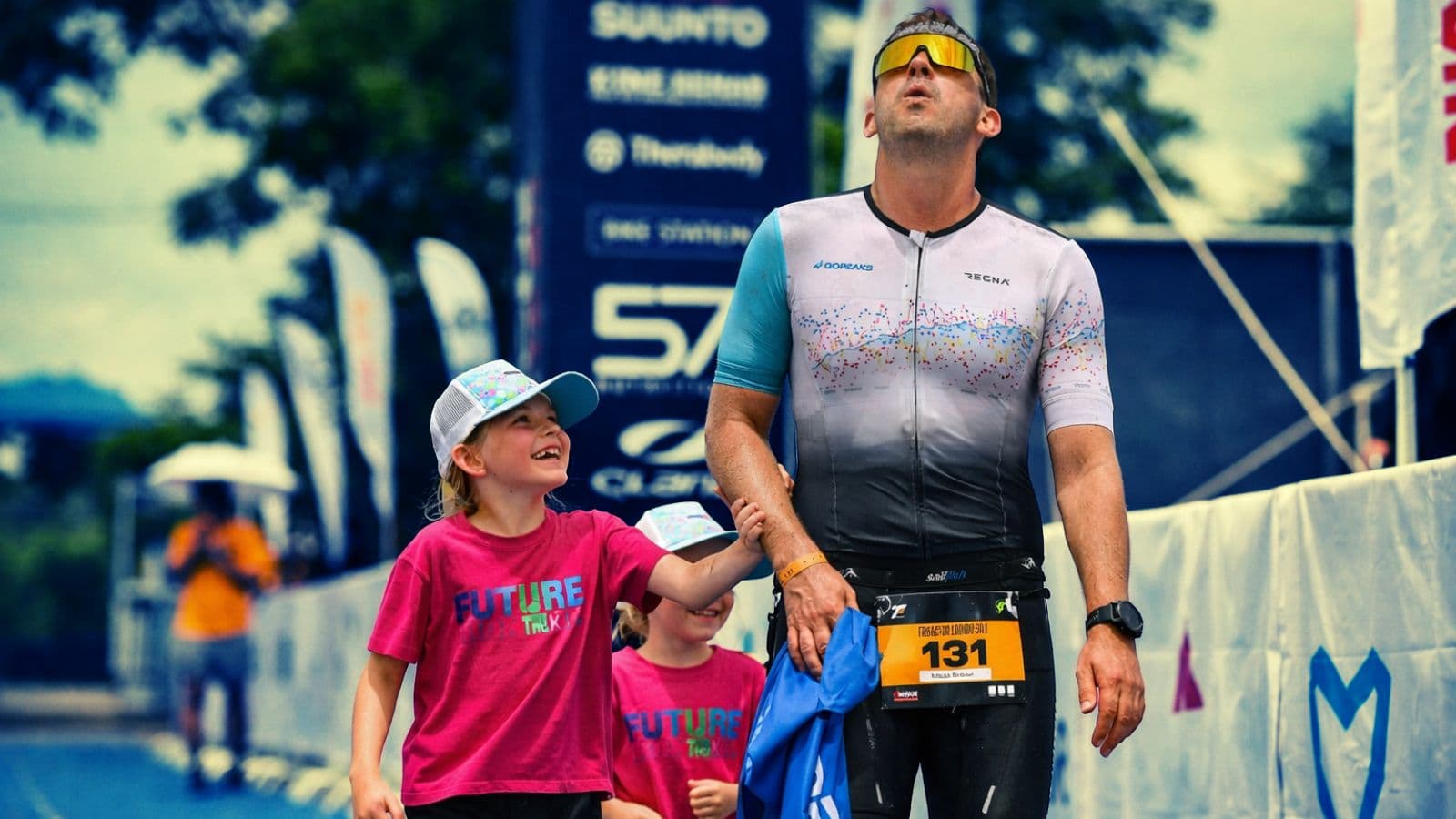
When Parents Are Ironman: The Role of Family in a Child Athlete’s Development Journey
When Parents Are Ironman: The Role of Family in a Child Athlete’s Development Journey
Over many years of building the GoPeaks community and the TriKids youth development system, we’ve observed something truly special: in many families where parents are triathletes—Ironman finishers—children often enter sports naturally, over time.
No one forces them.
No performance KPIs are imposed.
There is no pressure that “you must be like your parents.”
Children simply grow up in an environment where:
Parents wake up early to train.
Parents are disciplined with sleep and nutrition.
Parents pursue long-term goals.
Parents face challenges instead of avoiding them.
And then one day, the child says:
“I want to try too.”
That is when the development journey truly begins.
Three Key Factors in Developing a Young Athlete
In youth athlete development, there are three foundational factors:
Innate physical capacity – genetics and natural talent.
Training structure – coaches, education systems, and methodology.
Social environment – family, friends, and community.
The first factor cannot be changed.
The second depends on the choice of training environment.
But the third—family—is the foundation.
Without family support, it is extremely difficult for a young athlete to develop sustainably. Yet when support exceeds healthy boundaries, it can unintentionally create unnecessary pressure.
At TriKids, we consistently emphasize one core principle:
Parents are not coaches.
Parents are the environment.
The True Role of Parents
Most parents want the very best for their children. But “the best” does not always mean “the fastest.”
Some parents have shared:
“I didn’t have access to proper training when I was young, so now I want my child to have everything.”
“My child has talent—should they train seriously early to break through?”
These questions come from love. But it’s crucial to understand: youth sports are not a short-term race.
Sustainable development requires:
Time
Joy
Diverse experiences
Voluntary participation
Children need permission to try, to make mistakes, to fail—and to learn how to get back up. This is how resilience is built—the ability to recover mentally—one of the most important skills in both sport and life.
When Parents Are Athletes
In “Ironman families,” the most valuable thing isn’t achievement.
It’s the example.
Children learn more through observation than instruction.
When parents:
Never skip training, even in bad weather
Patiently commit to a 6–9 month goal for a race
Remain calm in the face of failure
Children naturally absorb those values.
Intrinsic motivation cannot be forced.
It can only be nurtured.
And when a child says, “I want to,” that’s when real development begins.
What Do Coaches Do? What Do Parents Do?
A healthy training environment requires clear roles.
Coaches are responsible for:
Designing training programs
Developing technical skills
Building long-term structure
Monitoring progress
Parents are responsible for:
Creating a stable environment
Providing emotional support
Handling logistics
Modeling a healthy lifestyle
When there are too many “coaching voices” from the outside, children can become confused. This reduces confidence and personal responsibility.
If parents have concerns, they should communicate directly with the coach—rather than adjusting the child during training sessions.
Early Development or Proper Development?
For children under 14–15 years old, top priorities should be:
Fundamental movement skills
Exposure to multiple sports
Maintaining joy and fun
Early specialization may bring short-term results, but it significantly increases the risk of burnout, injury, and loss of motivation.
Many studies show that long-term successful athletes often played multiple sports during childhood. This builds comprehensive coordination, balance, strength, and tactical thinking.
At TriKids, we are not searching for “12-year-old champions.”
We are building healthy, confident, and disciplined individuals for the long term.
When Should You Consider Changing a Coach?
Coaches play a critical role in a child’s development. A good coach:
Communicates clearly with parents
Creates a positive environment
Encourages rather than belittles
Provides specific, constructive feedback
If a child feels uncomfortable, overly pressured, or no longer enjoys the training environment, parents should seek to understand the root cause.
It’s important to distinguish between:
A child disliking the sport
A child disliking the current environment
If the environment isn’t right, change is normal.
If a coach tries to prevent a child from progressing to a higher level for personal benefit, that is a serious red flag.
Remember: Children Are Still Children
No matter how much potential they have, children still need:
Free play time
Creative space
A sense of safety
The ability to choose
Sport should never become a source of isolation or excessive sacrifice. At this age, flexibility and joy matter more than rigid discipline.
When children are raised in a positive environment, their chances of staying engaged with sport long-term increase significantly.
Develop the Person Before the Performance
At GoPeaks and TriKids, we believe:
You cannot create great athletes without first building strong individuals.
Discipline, confidence, responsibility, and resilience are values that sport can provide—but only when nurtured in an environment of:
Respect
Communication
Joy
Patience
If one day your child says:
“I want to become an Ironman like my parents.”
We will begin—but not with pressure.
We begin with a long-term plan, aligned with proper development stages and the right timing.
Because the ultimate goal isn’t just a medal.
It’s a lifelong, sustainable journey in sport.
Gopeaks & TriKids
Building Stronger Humans Before Stronger Athletes.