
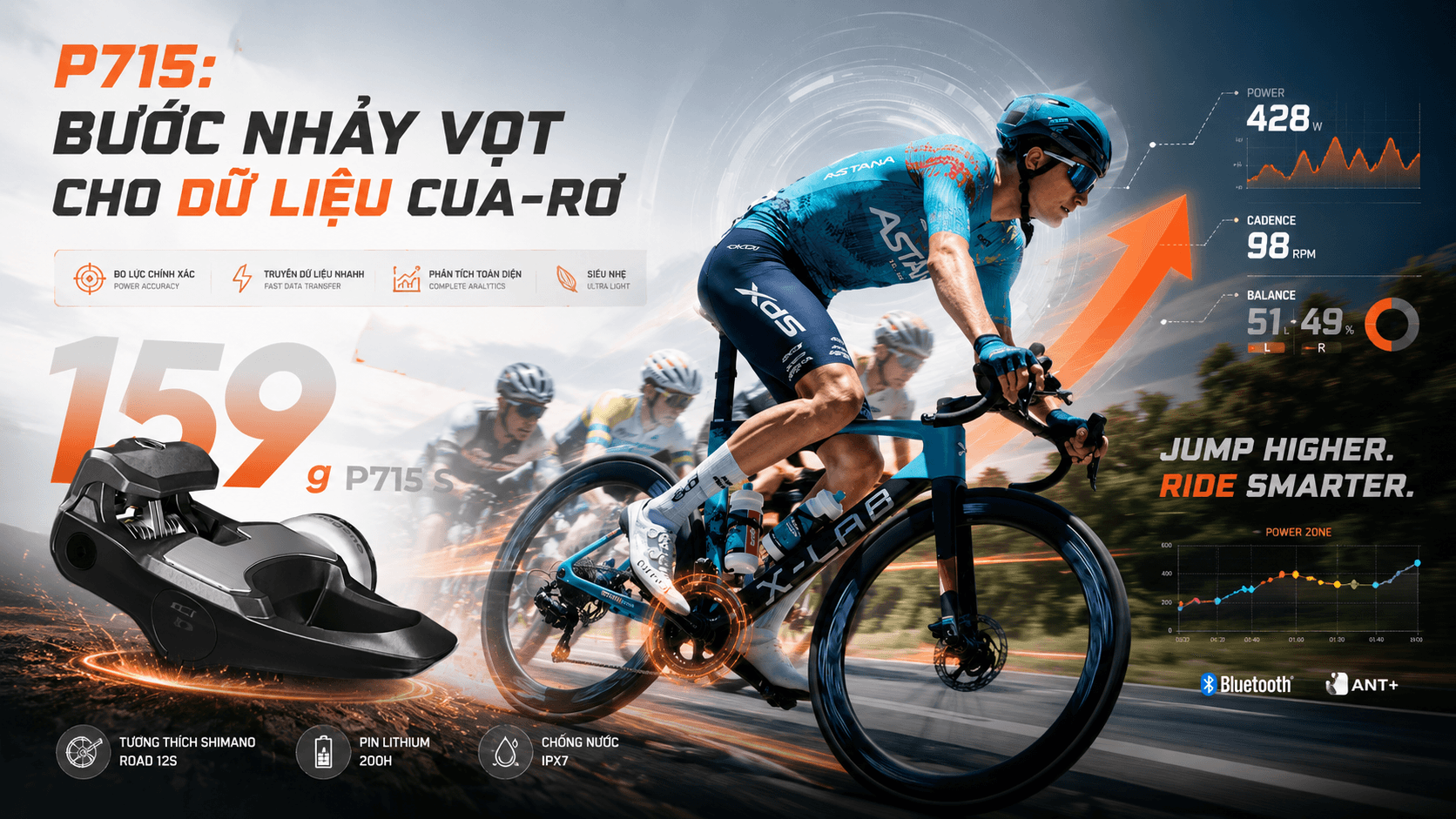
The Shift Toward Pedal-Based Power in Vietnam's Racing Scene
Vietnam's competitive cycling scene is evolving fast — and athletes who train on feel alone are getting left behind by those who train on data.
Precision-driven racing is no longer exclusive to European pelotons or professional triathlons. Across Vietnam, from criterium circuits to long-distance tri events, riders are demanding the same quality of performance data that elite athletes rely on worldwide. The Magene P715 cycling power pedals sit at the intersection of that demand and real-world accessibility — offering professional-grade measurement without the complexity of crank-based installations.
Pedal-based power meters have become the modern standard because they install in minutes and transfer between bikes instantly.
This versatility is a genuine advantage for Vietnamese triathletes who switch between road and TT setups on race week, since the entire measurement system moves with the pedals — no recalibration rituals, no additional hardware. According to Magene's official product specifications, this transferability is a core design principle of the P715 platform.
For riders already exploring dual-sided power options, the P715 represents an accessible entry point into high-spec engineering. The real question, however, is whether its ±1% accuracy specification holds up under the scrutiny that serious racing demands.
Unpacking the ±1% Accuracy: Is the P715 Truly Professional Grade?
Accurate power data isn't a luxury for competitive cyclists — it's the foundation every training decision is built on. The Magene P715 achieves this through high-precision strain gauges embedded directly in the pedal axle, capturing force vectors across the full pedal stroke rather than estimating from a single load point. Paired with advanced compensation algorithms that continuously correct for temperature drift and mechanical variance, the result is data you can actually trust.
The P715 delivers ±1% accuracy specification — matching the threshold elite teams demand from professional-grade equipment.
For context, ±1% is a common benchmark in elite racing. When debating options like magene p715 vs favero assioma, accuracy parity matters — but so does how that accuracy is sustained under real-world conditions.
The compensation algorithms do three critical things:
Eliminate thermal error — pedal temperature swings during long climbs or hot midday rides don't skew watt readings
Normalize zero offset — automatic calibration keeps baseline readings consistent across every session
Correct torque linearization — ensures power output is accurately calculated across both low- and high-force efforts
For pacing and training load management, unreliable data creates compounding errors in zone targeting and race-day strategy. The P715's accuracy isn't just a spec — it's what makes structured training measurable.
Of course, accuracy on paper only matters if the hardware holds up in Vietnam's demanding climate — which leads to an equally important question.
Built for the Tropics: Durability and the IPX7 Advantage
Vietnam's climate is a power meter's worst enemy — and hardware that can't survive monsoon season has no place in serious training.
Tropical conditions demand hardware engineered to the same standard as the data it produces. Afternoon downpours, humidity that rarely dips below 70%, and post-ride condensation create a punishing environment for precision electronics. The P715's IPX7 waterproof rating means it can withstand submersion up to one meter for 30 minutes — well beyond what any typical training ride or race-day storm will throw at it.
Technical Spec: IPX7 waterproof rating with a fully sealed magnetic charging interface, eliminating exposed ports as a moisture ingress point. (Source: Magene Global Support Documentation)
Where many competing power meters rely on USB-C or proprietary port covers — each a potential failure point after repeated wet-weather use — the P715's magnetic charging interface removes that vulnerability entirely. No port cap to lose, no corrosion pathway to develop over a season of hard riding.
Technical Spec: CNC-machined 7075 aluminum alloy construction provides structural rigidity and actively resists material fatigue under sustained pedal load. (Source: Magene Fitness Technical Datasheet)
Material integrity directly protects data integrity. 7075 aluminum — the same alloy grade used in aerospace applications — prevents the micro-flex that cheaper housings experience under torque. That structural stability is what keeps strain gauge readings consistent over thousands of kilometers, preventing the power data drift that quietly undermines long-term training analysis. For athletes also considering options like the spider-based alternative from Magene, the pedal-form factor of the P715 offers a uniquely portable solution without sacrificing build quality.
When comparing the magene p715 vs assioma duo on durability credentials, construction quality is just one dimension of the real-world comparison — battery life and local support matter equally, as the next section explores.
Magene P715 vs. Favero Assioma: The Real-World Comparison
Any serious magene p715 power meter review must stack it against the most prominent alternative in its price range — and the differences matter more than the spec sheets suggest.
Feature | Magene P715 | Assioma Duo |
|---|---|---|
Accuracy | ±1% | ±1% |
Battery Life | Up to 140 hours | ~60 hours |
Dual-Sided Sensing | Yes | Yes |
Stack Height | Low-profile design | Slightly taller body |
Connectivity | Bluetooth + ANT+ | Bluetooth + ANT+ |
Local Vietnam Support | Yes — via Magene.vn | No local distributor |
Battery life is where the P715 pulls decisively ahead. At up to 140 hours per charge — with a standby time exceeding 360 days — the P715 is built for multi-day touring and back-to-back endurance events that would leave competitors scrambling for a USB port. The alternative manages roughly half that runtime.
Physical profile also tips in the P715's favor. Its lower stack height reduces the risk of ground strikes on tight corners — a practical concern on Vietnam's varied road surfaces.
On the other hand, local support may be the most underrated differentiator. Warranty claims and technical issues are handled domestically through Magene.vn, eliminating international shipping delays. For riders considering entry-level alternatives, the P515 range offers a compelling step-up path within the same support ecosystem.
These hardware advantages become even more compelling when paired with the P715's advanced connectivity and training metrics — which deserve their own closer look.
Advanced Metrics for Competitive Edge
Every serious magene p715 review surfaces the same conclusion: raw power numbers alone don't win races — how you apply that power does.
The P715 supports 7 advanced training functions alongside dual Bluetooth and ANT+ protocols, meaning it integrates seamlessly with virtually every head unit, training app, and smart trainer on the market. No adapter workarounds. No data gaps.
Three metrics stand out for competitive riders:
Torque Effectiveness: Measures how efficiently each pedal stroke converts force into forward motion. A higher score means less wasted energy — critical in long-distance events where inefficiency compounds over hours.
Pedal Smoothness: Quantifies how evenly force is distributed across the full 360° rotation. Choppy, uneven strokes spike fatigue. Consistent smoothness extends endurance.
Left/Right Power Balance: Identifies asymmetries before they become injuries or performance ceilings. In practice, even small imbalances — 52/48 splits — can signal technique flaws worth correcting.
Pairing the P715 with a compatible GPS computer unlocks the full picture. The Magene C-series head units display all metrics in real time, creating a closed feedback loop between effort, form, and output. For riders who also train after dark, integrating a smart lighting solution into the same ecosystem keeps every session consistent and safe.
That combination of precision data and ecosystem depth is what separates the P715 from simpler alternatives — and it sets the stage for a clear verdict.
The Bottom Line: Why the P715 Wins for Vietnamese Riders
The Magene P715 is the pedal-based power meter that checks every critical box for Vietnam's serious cyclists — precision, durability, endurance, and local support all converge in a single platform.
Here's what the evidence consistently shows:
±1% Accuracy: Professional-grade precision matches what WorldTour athletes rely on, making every watt measurable and every training decision defensible — not guesswork.
Tropical Durability: IPX7 waterproofing and CNC-machined alloy construction mean monsoon season and humid mountain climbs won't compromise your data or your hardware.
Endurance Ready: A 140-hour battery life doesn't just survive Vietnam's longest gran fondos — it outlasts multi-day stage races without a single battery swap.
Local Reliability: As Magene Vietnam's authorized ecosystem demonstrates, every unit comes backed by genuine product guarantees and in-country warranty support — no gray-market risk.
In practice, the combination of these four pillars is rare at this price point. Alternatives may deliver on one or two factors; the P715 delivers on all of them simultaneously. For Vietnamese riders investing in performance data, that reliability extends beyond the road — it starts with where and how you buy. Choosing an authorized distributor is the final piece of the puzzle, and it's worth getting right.
Investing in Your Performance with Magene Vietnam
The right power meter is only as valuable as the support system behind it — and that's where buying through an authorized distributor becomes non-negotiable.
Riders who ask how accurate is the Magene P715S deserve a straight answer: ±1% precision, backed by a warranty that only applies when purchased through legitimate channels. Buying gray-market cuts that protection entirely.
Key reasons to commit with confidence:
Warranty protection — authorized purchase guarantees manufacturer coverage against defects and sensor drift
Replacement pedal bodies — Magene offers serviceable replacement bodies, meaning the precision internals stay protected for the long haul without replacing the entire unit
Effortless setup — the Magene utility app walks riders through calibration in minutes, removing any technical barrier between unboxing and first ride
Local technical support — Vietnam-based service means real answers, not generic email queues
For riders exploring Magene's broader ecosystem, the crank-based alternative is also available if pedal-based power isn't the right fit.
The bottom line: precision training demands a precision purchase. Visit magene.vn today and upgrade your data — and your results.